Showing posts with label Kalamata. Show all posts

Tuesday, October 14, 2014

Day 11: Olympia, Zakynthos


Plan for the day

We planned to visit two destinations, the first was archaeological site of Olympia and the second was Zakynthos island.

For the last part of journey we would need to drive our car onto a car ferry at Kyllini Port and sail to Zakynthos Island. I had got the go ahead from Budget Car Rental to drive the rented car onto a ferry. This agreement was very crucial or if there was any mishap on the ferry there would be no insurance coverage for the car.

Route for the day


Breakfast at Messinian Bay

Our room in Hotel Messinian Bay faced the sea and the view in the morning was very serene and refreshing. I sat at my balcony for a long time admiring the view and was reluctant to leave for my breakfast. 

View from our room
Breakfast was free as it was part of the room package. We ate our breakfast in the dining room cum bar. We seemed to be the only customers around as the dining room was empty except for us and a service staff. Surprising breakfast though was basic was very delicious and nicely prepared.


Lunch at Ambrosia

Unlike yesterday, today was a more relaxing day as we only had two destinations to visit. We left our hotel at around 10.30am and drove for about 2 hours travelling 120km to reach the Olympia town. The town was just before the archaeological site. The town was nice and modern with plentiful of hotels, shops and restaurants.

There was a lovely taverna called Ambrosia just beside the car park near the archaeological site. The taverna was very prettily decorated with many pots of colourful flowers, it looked very inviting and it served authentic Greek food. Since it was already 1pm we decided to eat our lunch before walking the Olympia site. Well the food at Ambrosia was as nice as the place looked.

Lunch at Ambrosia (Olympia town)


Archaeological Site Of Olympia (UNESCO)

From the car park we had to walk about 10 to 15 minutes before we entered the ground of Olympia and before we could see the ruins.

Philippeion
We were not expecting much from the site as based on my online research the site was very much a pile of rocks. We were visiting it because of its international significant. We headed straight to a familiar structure, it was the site where the Olympic torch was lighted a few months before the start of every Olympic Games. Finally I learnt the name of the structure, it was called Philippeion. This once elegant circular building was dedicated by Philip II, king of Macedon, a chariot racing Olympic Champion himself. The monument was completed by his son, Alexander the Great, after his assassination, in 336 BC.

The central part of Olympia was dominated by the temple of Zeus, with the temple of Hera parallel to it.

The remains of Zeus Temple
Olympia was the site of the ancient Olympic Games. It functioned as a meeting place for worship and other religious and political practices as early as the 10th century BC. The Olympic Games were closely linked to the religious festivals of the cult of Zeus, but were not an integral part of a rite. The Olympic Games started back in 776 BC, they continued for nearly 12 centuries until Emperor Theodosius decreed in 393 AD that all such "pagan cults" be banned. 

It was a great pity that Olympia was in such a poor state today. Most of the columns had fallen onto the ground into many pieces. The whole site looked like a huge 3-D jigsaw board with so many stone puzzle pieces all over the place. How I wished somebody could piece them together again! Wishful thought that would not happen in my lifetime.

All that was remained of the stadium was this arch entrance, The Krypte 

The Krypte
The largest building (ruin) at the the site was the Leonidaion, it was a sort of a luxury hostel that housed important athletes and guests taking part in the Olympic Games at Olympia. 

Leonidaion
Leonidaion was constructed around 330 BC and was funded and designed by Leonidas of Naxos (a benefactor and an architect). The original building had a square central open court surrounded by 44 Doric peristyle columns. On each side of the square court were rooms. Outside the rooms ran continuous rows of Ioanian decorated columns, 138 in total. 

At the site all we saw were rows of pedestals and not row of Ioanian or Doric style columns. 

On the surface the archaeological site of Olympia were just piles of rocks. Though there was not much to see, I did not regret visiting it. When I walked among the ruins and read the information tablets detailing the significant of a building, it usages, its history and its graphic mock up, I was able to picture the structure in my mind and the grandiose of this place back in history. 


Kyllini Port

We drove for about an hour from Olympia archaeological site to Kyllini port which was 65 km away. This was a port on the Ionian coast on the mainland side and was served by a number of ferry routes to several Ionian islands. We reached the port at about 5pm and bought ferry tickets for four adults (€7.60 per adult) and one car(€37.90) to Zakynthos

Route of Kyllini Port
The ferry was very huge, with two lower decks for cars and two upper decks for passengers. The passenger decks were comfortable with sofa chairs and tables and cafeterias. The ferry trip to Zakynthos took about 60 minutes.

We were at Zakynthos to visit its world famous "Shipwretch cove", and my impression of the island was one with long stretches of beautiful beaches. I thought the port town would be a quiet place and did not expect to see a densely built up port town when we arrived at Zakynthos Island.

Sailing into Zakynthos Port
The convenient of having a car was once the ferry berthed we got into it, drove out of the ferry, out of the port and into the town. No time wasted at all.


Dinner and Night shots

When I was in the ferry, I used my handphone to carry out some online searches for hotels with reasonable room rates, good reviews and preferably at the port front of Zakynthos . I found Dali Hotel which seemed to the best among them. After the ferry berthed we only needed to drive 1 km to Dali Hotel. 

We left our luggage after booking two rooms and drove uphill on the route that the hotel owner had drawn for us on a map. There was a cafe beside a church up the Bochali hill that had a "fantastic" night view of the harbour, that was what he said. 

Unfortunately we were unable to find the cafe. The sun had set, the roads up the hill were not well lighted, the driving instruction marked on the paper map was not clear and after making several wrong turns into dead ends and driving onto road that was too narrow and steep to be even called a road, we gave up and returned to port. How I wished I had insisted on marking the location of the cafe on my google map!

After dinner we drove to the jetty to take some night shots of the port front. Absolutely stunning.

Zakynthos Port Front with Church of St Dionysios
Though we did not manage to find the cafe that was beside a church up in Bochali Hill earlier in the evening when we drove up the hill, we somehow manage to find it through our camera lens when standing at the Jetty. It was the most colourfully lighted place on the hill above the port town. We could see the red sun umbrellas of the outdoor cafe.

Cafe beside Church on Bochali Hill
Too bad we did not manage to find the place for I was sure the night view of the lighted port and town would be fantastic from up there.


Our Accomodation for the Night - Dali Hotel


Dali was a four storey building. Its owner was a very friendly man. We paid €50 for each of the two rooms that we took. The rooms came with free breakfast. The owner was kind enough to offer my husband and I the honeymoon room without extra charge.

Hotel Dali
The rooms in Dali Hotel were very luxurious well worth the money we paid. The only shortcoming was that there was no lift from the first to the second level, luckily the owner was very kind to help us bring up the luggage.

Our honeymoon room was on the roof level which was divided into two sectors. One sector faced the front and was the living quarter of the owner and his family. Our room and balcony was in the other sector that faced inland. The balcony was huge and it offered a wonderful view of the town. At night we could see the lighted rooftops of the houses inland and several church towers that were built mid level on the hill.

Night scene from the balcony of our room 

Beautiful room and bathroom

Monday, October 13, 2014

Day 10: Nafplion, Mystra & Kalamata


Plan for the day

We planned to spend the morning exploring Nafplion. By about mid morning we would drive southwest to Mystra, one of the most exciting and dramatic historic sites of Peloponnese, an UNESCO site. We needed not leave Mystra until sundown when we would drive west to Kalamata for the night.

The total distance from Nafplion to Mystra to Kalamata was 180 km

Route for the day
We achieved all our target destinations for the day.


Morning walk on the Promenade

We woke up early at about 7 am and went out to have a morning stroll on the waterfront promenade just outside our Hotel. The promenade was quiet, the carpark lots were free of car, the cafes and restaurants were still shut.

I was most glad to have booked a hotel at the "best" location (in my opinion) in Nafplion as the hotel was close to some of the great sights of the city. We loved to photograph scenery early in the early morning just when the sun rays appeared, staying at a hotel near the sights helped us to save a great deal of time as we did not have to wake up earlier to get to the site.

Morning waterfront view just outside our hotel


Walking around Nafplion Old Town

I intentionally left out the breakfast option when booking our room with Hotel Agamemnon because I knew that there would be many cafes along the waterfront promenade and I wanted to have a more exciting breakfast than those boring ones from the hotel.

Nafplion Old town in the morning
We walked about two units to the right of our hotel and sat at the outdoor cafe of Rendezvous Restaurant and had our breakfast. Rendezvous was one of the restaurants that started business early.

After breakfast we strolled around the old town square (syntagma square) and a few other alleys. In the day time the old town still looked as picturesque as it did at night time. At night the warm light of the street lamps casted a uniform golden glow on all the buildings. In the day, the sunlight brought out the soft and strong colors of the buildings giving the area a different look.


An elevator going up to Akronafplia Fortress

The day before we had parked our car up the hill a bit of a distance from our hotel. Today with the help of my google map we took shortcuts, walking through alleys and going up steps to the carpark. This walk through the alleys was different because instead of walking past the usual shops, cafes and restaurants we were walking past living quarters. The alleys were clean and quiet, the doors of all the houses we passed were shut, we did not meet a single person and I wondered where were all their occupants. Were the adults at work and the children in school? 

It seemed like the locals loved to paint the doors and windows of their houses in bright color and I could not resist taking a photo with one which was painted in bright red shade so similar to that of my fleece jacket.

Alley passing living residential houses
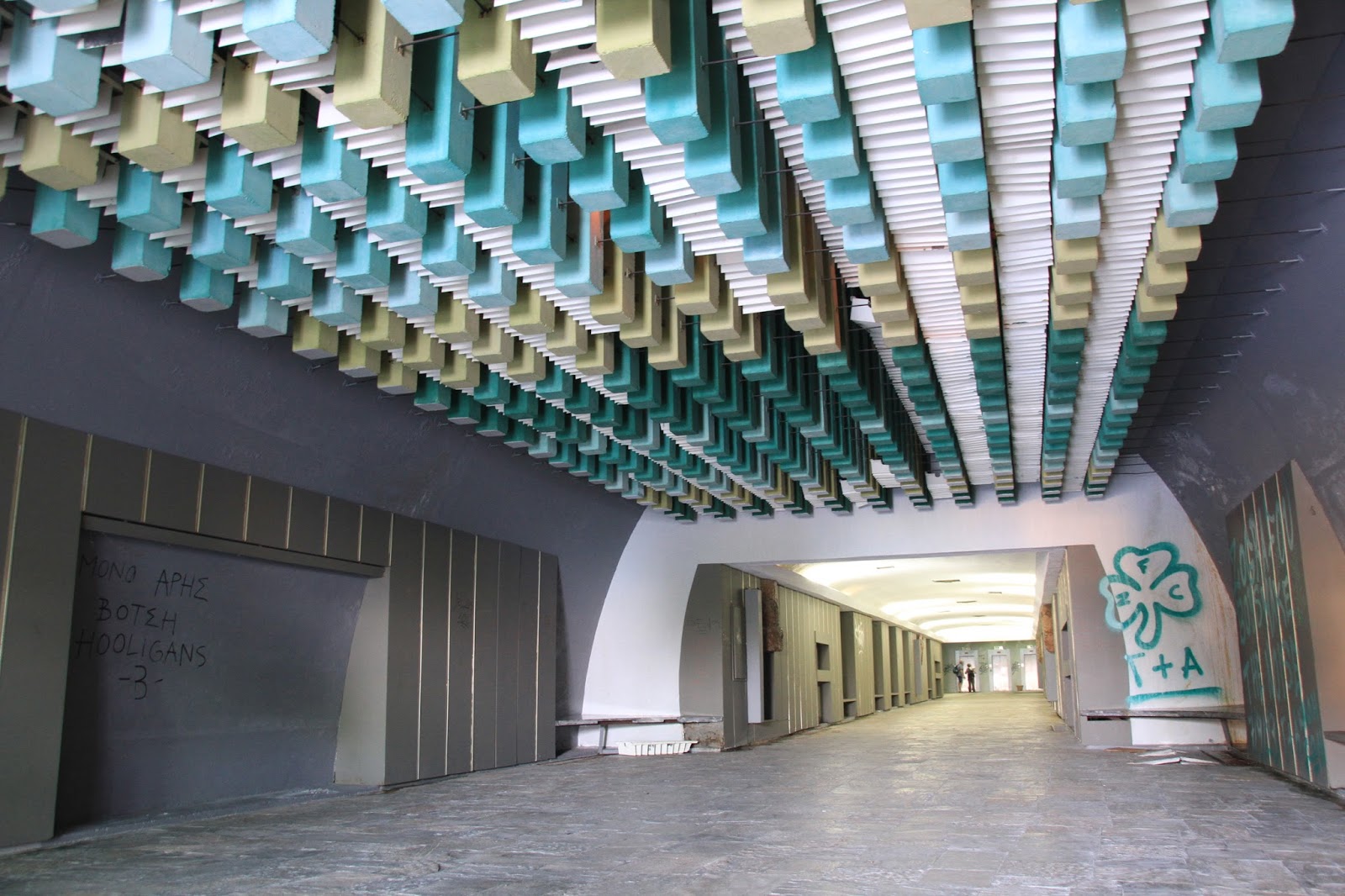
When we were at the carpark, we saw an interesting structure that seemed like a tunnel built into the hill. Since there was no "No Entry" sign in sight do we walked into the tunnel to explore.

Location of the tunnel to the lift going up Akronafplia Fortress
It was a well lighted and very wide tunnel that had very interesting and complex decoration on its ceiling. It looked like some sort of a bunker. The tunnel was very long, so I guessed we were walking deeply into the hill above us.

At the end of the long tunnel we saw three lifts. There was a couple ahead and they were dressed just like us and not in army fatigues or formal office wears. This gave us the assurance that we were not intruding into a restricted area.

Tunnel to lift
We went into the lift which only had one button for an upper level. Stepping out at the upper level we were so surprise. The lift had brought us up to Akronafplia Fortress! So this was a shortcut! Without this shortcut would mean a 3 km round trip to and from Akronafplia Fortress.

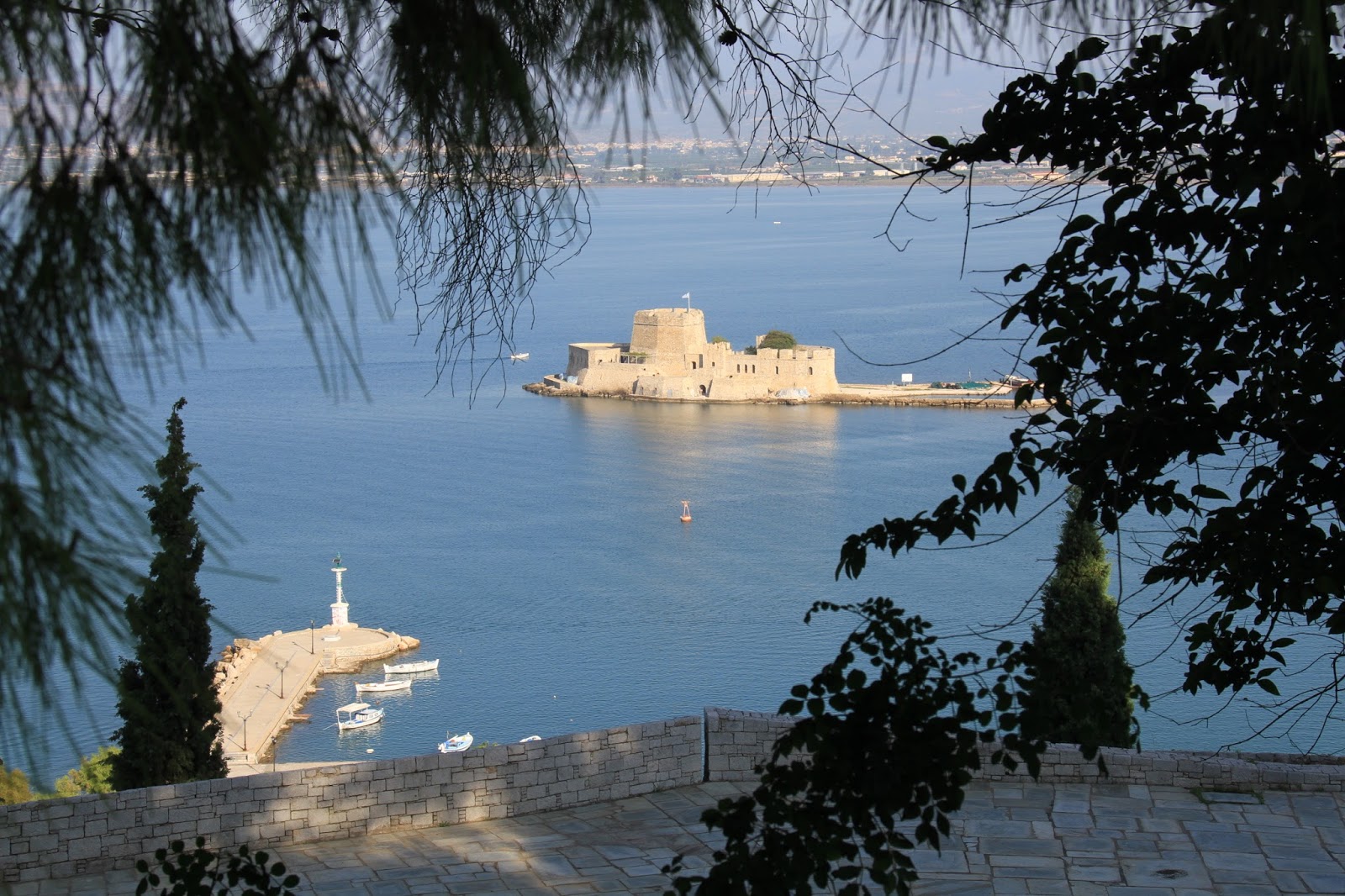
Since we were up at the Akronafplia Fortress we could not resist taking a few more photo shoots of the "floating" Bourtzi Castle in the water.

Bourtzi Castle


Mystra

We drove about 150 km to Mystra and our journey took about 1 hour 45 minutes. Near the end of our journey we passed the town Sparti which was the modern day Sparta. We drove through the town without stopping anywhere as it was just an ordinary town with modern buildings and nothing captured our attention.


Route to Mystra

From Sparti town to Mystra town we drove passed a stretch of narrow, poorly maintained road with farms on both sides. These were not open farms with wide fields but farms with short trees messily planted on the land.

For a while we thought we were on a wrong road because it felt as if we were crossing someone's backyard. We persisted on, trusting our car GPS and after a while we were back on to a proper road again. 

Map of Mystra Archaeological Site
We reached Mystra town a quaint looking town but the town was not our destination we still needed to drive further uphill to the ancient Mystra site just a short distance away.

The archaeological site of Mystras was a relict townscape from the 13th century. It occupied a steep foothill on the northern slope of Mt Taygetos. Ancient Mystra started as a castle but the inhabitants of nearby Sparta fled to this safe place and developed it into a city.

Old illustration of Ancient Mystra
Ancient Mystra was a fortified city, it was layered into Lower City, Middle City and Upper city on the slope of the hill. Fortified walls were built at each layer.

We had allocated ourselves 5 hours to explore this amazing archaeological site. The site was huge with many byzantine ruins all over the slope of the hill. To explore every ruins would need more than 5 hours so we planned to explore the must-visit fortress, palace, churches, monasteries and metropolis complexes.

We drove around until we came to a carpark where we saw a ticketing booth and got out to buy our entrance tickets. Apparently there were two entrances to the same archaeological site, one near the Upper City and the other nearer to the Lower City. The ticketing staff advised us to explore the Upper City first then drive down to the other entrance where we could use the same ticket to enter and explore the Lower City.


Villehardouin Castle 

At the Upper City our first target was the castle. The Villehardouin's castle was at the top most part of the Upper City and it was a long windy walk up the hill on hard uneven stone path.

The castle was built by William II of Villehardouin, a Achaea Prince. Unfortunately before the castle was completed, Mystra was handed over to the Byzantine Emperor, Michael VIII Palaeologus after the Archaea Prince was defeated at the battle of Pelogonia in 1259. 

The castle looked very huge and its stone walls were very tall and massive. It looked impenetrable. We entered the castle compound and like most ruins only the strongest building elements remained which in this case were the stone walls. 

Villehardouin Castle
I picked my way carefully as I stepped over uneven stones along the castle wall walk going round the perimeter. Standing at the south-east end of the wall walk I saw a view that was absolutely mesmerising. The vastness of the land before me and the dramatic steep drop from the top of the wall to the ruins of the lower city below was a breathtaking scenery.

Castle wall walk


Agia Sophia

Agia Sophia was located in the upper city near to the entrance of the archaeological site. Externally the ruin structures looked quite intact. Besides its wall, its roof was still standing. I found the Byzantine architecture very lovely, from the tiled dome roofs to the brick walls to the arched windows. I particularly liked its sandy color and the different shades of orangey tone of its structures. 

Agia Sophia
When we walked into the church we were pleasantly surprise to see frescoes on the underside of the high dome.

Frescoes inside Agia Sophia
More frescoes were seen when we walked into the two chapels, one of which was entered from within the church and the other through a door outside the church. The frescoes depicted Biblical scenes and images of Christ, the Virgin Mary and other saints.

Agia Sophia was built by the first Despot, Manuel Kantakouzenos Palaiologos circa 1350. It was intended to serve as the palace church but in 1365 it was turned into the katholikon of a monastery by Patriarchal decree. 


Palati tou Mistra (Palaces)

The palaces of the despots of Mystra was a complex of buildings built at different times. On the path down from the castle we could see the roof of the palaces. The palaces were undergoing restoration we could see layers of scaffolds on the perimeter of the L shape complex and heavy machinery sitting on the palaces ground. The area looked out of bound so we only viewed the palaces from the top.

Palaces below the castle


Pantanassa Monastery

We drove to the entrance nearer to the Lower City and using the same tickets that we had brought at the earlier entrance we entered the archaeological site again. After passing the entrance and walking a short distance we could see Pantanassa Monastery on the upper slope.

Pantanassa Monastery
Monastery look very majestic with its long wall and its five domed tower. It was built in 1428 and was the only monastery that still had nuns dwelling within its walls. 


Metropolis

Metropolis
At the Lower City there was also a huge church called Metropolis. It was the oldest church in ancient Mystra and was dedicated to Agio Demetrios. The Metropolis was built in 1264 by its first bishop Evgenios to be the Metropolitan Church of the brand new city.

As we stepped through the white arch gate of the church we walked into a sunken courtyard. The sunken courtyard was large as this was a metropolitan church which needed to hold the masses of the community.

Entrance to the Church Compound
Around the courtyard were two storey buildings with connecting balcony that overlooked the courtyard. On one side of the courtyard was stone sarcophagus that was used for water storage.

Interior of Church


Kalamata city for the night

I had not prebooked any accommodation for the night as the plan was to either stay at Mystra or Kalamata depending on when we could finish exploring Mystra. Since it was early by the time we finished exploring Mystra, we decided to drive on to Kalamata for the night.

Route from Mystra to Kalamata
Kalamata was the nearest city to the west of Mystra and would be a good place to stop for the night. The distance was about 57km and it took us about 1 hour and 15 minutes to reach the city. Kalamata was along the coast of Messenian Gulf.

Just when we were about to reach Kalamata I used my handphone to surf for a hotel that was offering rooms at reasonable rate. I found Messinian Bay Hotel a hotel that faced the sea, with good reviews and reasonable rate for a double room at €55 inclusive of breakfast.

Messinian Bay
We drove straight to the hotel and from the exterior of the hotel we were not disappointed. It looked good and new. We walked in and booked two rooms at the hotel. The room was a good size, with ensuite bathroom.

We dumped our luggage in our rooms and left the hotel in search for a place for dinner. Near to our hotel we did not find any restaurant so we drove along the coast for about 3 km before we came to another section of the coast which looked busier. There were many hotels and restaurants along the stretch. We stopped at a place called Morales Pizza for dinner. 


Morales Pizza (Co-ordinates: 37.024719, 22.118834)

We did not sit indoor at the restaurant but crossed the road to sit at the its outdoor dining area on the beach. The place was very quiet as the tourist season was over and we four were the only customers. The pizza was cheaply priced and value for money.